As the year creeps closer to winter, Jewish communities across the world are gearing up to celebrate Hanukkah, the Festival of Lights. Hanukkah celebrations begin sundown on the 25th day of the Jewish month Kislev. This year, the date falls on December 14th, and for eight days, families will gather to celebrate this ancient miracle.
The holiday’s origins date back to the 2nd century B.C., during the time when Jewish rebels revolted against foreign forces, reclaiming and rededicating the Second Temple in Jerusalem, a sacred Jewish worship center. What was supposed to last only a day became a discovered trove of oil that kept the temple’s menorah alight for eight days.
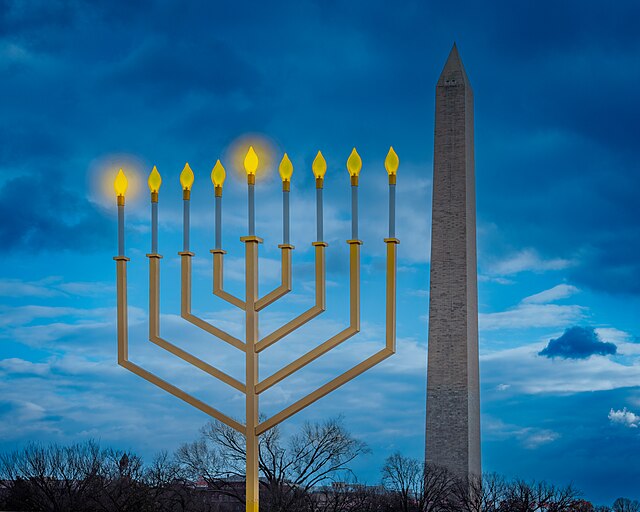
To symbolize this miracle, Hanukkiah (or Hanukkah menorahs) have eight candle holders plus one for the shamash, or the helper candle. For each of the eight nights, candles are placed right to left, then from left to right each night, an additional candle is lit using the shamash.
A homage to the miracle of the oil, traditional Hanukkah foods are fried in oil. The most widespread, however, are latkes and sufganiyot. Latkes, also known as levivot, are crispy, savory fried potato pancakes, often served with applesauce. Equally delicious are sufganiyot (pronounced soof-gah-nee-yoht): deep-fried, jelly or custard-filled doughnuts, the perfect sweet treat to top off this wholesome Jewish holiday.
While timeless Hanukkah songs like “Hanukkah, Oh Hanukkah” and “I Had a Little Dreidel” play in the background, families also enjoy a classic game of dreidel. The dreidel is a four-sided spinning top labeled with four Hebrew letters written on each side: nun, gimel, hey, or shin. The letters represent the first four letters of the Hebrew saying “nes gadol haya sham,” which means “a great miracle happened there.” Players create a pot of tokens, candy, or gelt, which are chocolate coins, and then they take turns spinning the dreidel. Whatever letter the dreidel lands on gives the player a different direction: Nun (נ) means the corresponding player takes nothing from the pot. Gimel (ג) means the player takes everything in the pot. Hey (ה) means half of the pot, and shin (ש) means the player must place pieces in the pot. Depending on the family rules, the game ends after a set time limit or when one player has collected all the tokens.
For those looking to celebrate, there are many events in the D.C.-Maryland-Virginia (DMV) area. One popular event is the National Menorah lighting ceremony in the United States’ capital, Washington, D.C. Attended by thousands each year, visitors enjoy food, music and entertainment.
For friends of those who celebrate, saying 'Hanukkah Sameach' or 'Chag Sameach' means 'Happy Holiday' in Hebrew. Beyond greetings, Hanukkah is a time for family, community and celebration.