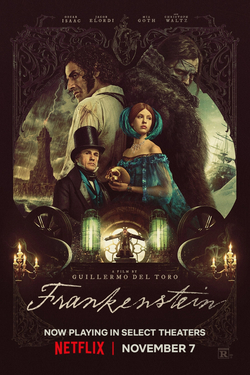
Guillermo del Toro’s long-anticipated adaptation of “Frankenstein” arrived as both a love letter to Mary Shelley’s novel and an unmistakable personal achievement. Known for breathing humanity into monsters, del Toro uses the classic story not to shock, but to ache. His film is less about horror than about the loneliness of being unloved, and the anguish associated with creating something for which responsibility cannot be taken.
The movie opens with the Creature pursuing Victor Frankenstein, played by Oscar Issac, across the frozen Arctic, framing the narrative like a haunting memory. The viewers are then pulled into Victor’s past: his fascination with science, his grief after the death of a loved one, and the ambition that eventually consumes him. Del Toro leans into this emotional core, portraying Victor not simply as a mad scientist but as a man desperate to outwit death and terrified of his own success.
One of the most striking aspects of the film is its visual world. The sets feel simultaneously grand and decaying, as though every wall and window holds a secret. The laboratories and estates reflect del Toro’s signature style: gothic, ornate, slightly surreal. The lighting is rich with deep shadows, vivid reds and sickly greens, giving the world its own emotional temperature. The score enhances this atmosphere, drifting between somber, delicate melodies and crashing bursts of dread.
At the heart of the film is Jacob Elordi’s character, the Creature, played with both imposing physicality and aching vulnerability. Del Toro refuses to turn him into a mindless monster. Instead, he portrays him as a being born with intelligence, emotion, and the need to be understood, yet condemned for his appearance. His heartbreak grows as he learns language, philosophy, and morality, only to face rejection at every turn. The film emphasizes his longing for connection, making his anger not terrifying but tragically inevitable.
Victor Frankenstein’s portrayal is equally layered. He begins as an idealistic scientist chasing discovery, but slowly unravels into guilt and denial. His relationship with his creation becomes a twisted mirror of parenthood: Victor wants to forget he ever made the Creature, while the Creature wants only to be acknowledged. Their conflict feels like a battle between yearning and failure, rather than good versus evil, showcasing profound moral obscurity. This dynamic underscores responsibility and abandonment, forcing the viewer to question societal norms. The story is an examination of ambition’s dark consequences.
Despite its emotional strengths, the film does occasionally struggle with pacing. The middle act lingers perhaps too long on Victor’s internal torment, and some viewers may feel the movie pauses when they expect it to accelerate. There are also moments where the tone shifts abruptly, blending melodrama with violent horror in a way that may feel uneven. Yet even in its imperfections, the movie remains enthralling, because its ambition is sincere.
Del Toro’s “Frankenstein” is not designed to frighten audiences with jump scares or shocks. Instead, it unsettles by forcing viewers to sit with the consequences of creation without responsibility. It asks what makes someone a monster – the face they wear, or the way they are treated? It urges the viewers to see the humanity in the misunderstood and to recognize the danger in abandoning what humans bring into the world.
Ultimately, this adaptation stands as one of del Toro’s most emotional and thought-provoking works. It is visually mesmerizing, brutally tender and profoundly faithful to the spirit of Shelley’s novel, without feeling like a simple retelling. It takes the familiar and resurrects it with new breath and new sorrow. A film like this does not simply entertain; it lingers, it mourns, and it feels alive.